Rationalising the Qualifiers#
A briefing note on how the glossary’s qualifiers — the modifiers that refine a commodity (colour, weave, size, quality, origin, treatment: white, double, narrow, coarse, Holland, embroidered) — are being turned from a sprawl of loose spellings into a small, shared, controlled vocabulary. It is a companion to Why Glossary Curation Is Slow: the commodities have largely been curated and AAT-aligned; the qualifiers are the next layer.
The problem#
Qualifiers had grown the same way the commodity headwords did — by many hands, over 180 years, with no spelling standard. The result, before this pass:
~7,500 qualifier objects across ~1,050 commodity entries, but only a small lexeme set underneath: small alone appeared as ~600 inflected/spelled variants (
parvus,parva,parvi,parvum,parvuss…), and the same lexeme (white, Holland, coarse) was re-spelled and re-annotated separately on every entry it touched.~5,700 distinct surface spellings, of which only ~44% are actually attested in the annotated cargo records — the rest are speculative or never-reached.
Almost no identifiers: a handful of AAT/geo tags across thousands of qualifiers, because there was nowhere to attach them once.
The approach#
The design was agreed in discussion and is deliberately simple:
A shared canonical store (
docs/data/qualifiers.json). Each qualifier lemma is defined once — its label, its attested spelling forms, a gloss, and (where appropriate) its Getty AAT concept and a geographic identifier.Entries reference canonicals rather than repeating text: a qualifier becomes
{ref: "holland"}, a compound becomes an ordered{tokens: […]}sequence (with{lit}for connectives like de), and an un-lemmatised survivor stays as{raw}. An identifier set on a canonical then inherits everywhere it is referenced.Attestation-driven, and merged with sanitisation. The pass is scoped by what the records actually attest; spellings that never appear in the annotated cargos are pruning candidates, so tidying and pruning happen together.
Compositional compounds are decomposed into their atoms (holandie grossa → coarse + Holland); only non-compositional units (place names like St-Omer) are kept whole.
Polysemy machinery was deliberately left out — one canonical, one sense — to be revisited only if a real case demands it.
Prune by corpus-text occurrence, never by parser match. The first prune judged “never attested” by whether the span parser had tagged the qualifier — but a raw form the parser couldn’t yet attach counted as zero even when it occurs in the records, so ~1,235 genuinely-attested raws were dropped (e.g. muscadell on wine, loges on dudgeon). The metric was corrected to contiguous-n-gram occurrence in the normalised cargo text; the wrongly- pruned, text-attested raws were restored and the genuinely-absent ones left pruned.
How the work is divided#
The machine does the bookkeeping; the scholar makes the judgements.
A proposer (
process/qualifiers/cluster_qualifiers.py) reads the raw qualifiers, decomposes compounds, and clusters the surface variants into proposed canonicals using three composed signals: the curator’s existing pipe-grouped synonym families, shared spellings that bridge entries, and a consonant-stem merge for spelling variants. It harvests any existing gloss/AAT/geo, marks corpus attestation, and writes a reviewable proposal. Nothing it proposes goes live.A tolerant reader in the cargo parser was added so the new
ref/tokens/rawforms resolve to spellings exactly as the old text did — validated by a self-contained spike on the textiles entries that proved no attested spelling is lost and the parser’s output is unchanged.Every merge, split, relabel, prune and identifier assignment is a human decision. The proposal is reviewed in small thematic batches (colours, weaves, sizes, …); each batch is signed off — corrected where the clustering over- or under-merged, and given the right AAT concept — before it is written into the canonical store. The automated steps exist only to make that review tractable; they do not make the scholarly calls. (The planning, clustering and drafting here were steered with the project’s AI assistant, but the controlled vocabulary is the curator’s.)
This mirrors the wider lesson of the project: the machine can collapse ten thousand spellings into candidates and check that nothing was dropped, but it cannot decide that murrey is a mulberry-purple or that stricta and narrow are the same idea — those are period-knowledge judgements.
Why this is now feasible at all#
Two things deserve to be stated plainly.
The first is accuracy at scale. Reconciling several thousand qualifier spellings — tracking which surface form belongs to which lemma across more than a thousand entries, checking after every change that no attested spelling has been silently dropped, and cross-referencing each against the annotated corpus — is the kind of exhaustive bookkeeping that is effectively impossible to do reliably by hand. Done manually it would accrue errors faster than they could be caught.
The second is speed, and with it feasibility. When this two-year edition was proposed and funded, a controlled, identifier-aligned qualifier vocabulary on top of a cleaned commodity glossary was simply not within scope — there were not the person-months for it. Large language models have changed that calculus outright: the clustering, the corpus-wide attestation checks, the drafting and the validation that would have consumed months are now a matter of hours of human review over machine-prepared batches. It is no exaggeration to say the project’s AI assistant has been transformative — turning a task that could not have been contemplated within the original budget into one that is being completed as a routine part of the work. The scholarship — every identification and every judgement of sameness — remains, and must remain, human.
Progress#
Reviewed and written into the canonical store (per signed-off batch):
Batch |
Canonicals |
Notes |
|---|---|---|
Spike (textiles) |
— |
schema + tolerant reader validated; no spelling lost |
Colours |
20 |
white…grey with AAT colour concepts; scarlet/tawny/murrey/russet/columbine/dun via a broader AAT |
Weaves / structure / pattern |
14 |
single/double/half/plain/tissue/striped/figured/checked/marble (label-only); ribbed, diaper, damask, embroidered, raised with AAT |
Sizes |
6 |
small/large with AAT; narrow/broad/long/short label-only |
Quality / grade |
12 |
refuse, raw (=unfinished) with AAT; coarse/fine/old/new/wet/worked/counterfeit/royal/bastard label-only |
Materials |
9 |
wool/linen/silk/cotton/hemp/gold/silver/gilt/tinsel, each with its AAT material concept; silver split from gilt |
Provenance (places) |
99 |
every attested place given a Wikidata identifier, a point, and a polygon where one exists (six further towns — Newcastle, Winchester, Lucca, Levant, Montivilliers, Hamburg — added with the long tail) |
Cloth-type long tail |
102 + 19 merged |
named fabrics, threads, paper grades and treatments given a canonical with its gloss; variants folded into existing lemmas; 60 one-off unknowns left to migrate as raw forms |
Occupational / purpose |
8 |
cooper, weaver, shoemaker, tailor, saddler, fuller, cordwainer with AAT occupation concepts, plus crossbow (purpose); caught a sutor (= shoemaker) mis-glossed as “tailor” |
Provenance (more places) |
+11 / 9 merged |
Messina, Toulouse, Nuremberg, Bordeaux, Málaga, Canary Islands, Gascony, Cornwall, Rhineland, Arabia, Berflete etc. added; dup variants merged into Paris/Devon/Burgundy/Portugal/Ireland/Cyprus/France/Norfolk/Winchester |
Materials (cross-category) |
17 |
leather, earthenware, stoneware, bone, iron, wood, ivory, brass, copper, velvet, worsted, wicker, tapestry (with AAT) + mail/thrum/splint/broken; caught a clustering error merging broken into “leather” |
Furs, skins & leather |
~40 |
tanned/tawed/untanned split; fur cuts (belly, back, leg, paw, tail, neck, head); sources (squirrel, calaber, marten, fitch, cat, rabbit, lamb, kid, hart, cowhide, …); separated otter/rough from a garbage “raw” cluster |
Food & processing |
16 |
dried, in/out-of-season, salted, powdered, garbled, sugar-loaf, candy, fresh, comfect, Bay salt; wine-types malmsey/romney/cute/sweet |
Cross-category sweep |
~50 |
dup colour/size/quality variants merged in; new types (covered, empty, bound/unbound, painted, ostrich, knitted, children’s, Castile soap, parchment, currants, brazil, …); caught the kors garbage cluster (coarse+large+weak+refuse) |
The first themed batches were scoped to Textiles & cloth; the sweep above
extended the rationalisation across all commodity categories. The all-category
proposer clusters proved noticeably noisier — several garbage super-clusters
(brok = broken+skin+leather, kors = coarse+large+weak+refuse, rau =
raw+rough+otter) had to be caught and unpicked by hand. At that stage the vocabulary
stood at ~384 canonicals (later batches have taken docs/data/qualifiers.json to 654
at 17 November 2026); the remaining ~430 single-attestation one-offs were left to
migrate as raw forms rather than forced into false lemmas.
Migration and prune#
With the vocabulary consolidated, the live entries were migrated to reference
the store. Each entry.q item became a {ref} (3,815), a {tokens} compound
(742), or an un-lemmatised {raw} survivor — losslessly, with any spelling not
already in its canonical added back so nothing was dropped. The full corpus was
reannotated; qualifier coverage held (109,066 annotations, essentially unchanged,
with slightly more cargos covered), confirming the references resolve to the same
surface forms the legacy text did.
The order mattered: a prune attempted before reannotation would have deleted
legitimate paradigms (it wanted to drop grey, hemp, damask) because the
old annotations under-counted qualifiers — the very thing this work fixes. Run
after reannotation, the prune removed 2,041 never-attested {raw}
spellings — speculative or never-reached forms (childrens cappes, cloth of,
of the dedly syns) that match no cargo — while keeping the 947 attested raw
survivors. Because they never matched, no further reannotation was needed.
(These are the counts at migration. On 17 November 2026 the glossary’s q lists held
4,546 {ref}, 821 {tokens} and 1,303 {raw} items across 1,005 entries.)
Finally, every consumer was repointed through a single shared resolver
(docs/js/qualifiers.js for the browser, an equivalent reader in
generate_jsonld.py): the public glossary, the main-index cargo popovers (now
showing a qualifier’s canonical label, gloss, and linked AAT and geo), the entity
viewer and the editors all resolve ref/tokens/raw against the store, and
the JSON-LD emits the canonical AAT and provenance identifiers — set once, and
inherited everywhere the canonical is referenced.
Canonicals are curated in the Qualifiers mode of the Concept, Qualifier & Leftover Review tool.
Provenance: places, identifiers and geometry#
The largest single group — 84 place-clusters after merging — was the only batch needing geographic identifiers rather than Getty AAT. Each cluster was reconciled against the World Historical Gazetteer (WHG), which returns a candidate Wikidata identifier per name. That candidate is only a starting point: WHG scores on the name string, so the top hit for Cologne was a place in Italy, Constance resolved to Portugal, Ireland to Shetland, and Brunswick to a railway station. The decisive check was geometry — fetching each candidate’s coordinates and looking at where the dot actually landed exposed eighteen wrong auto-matches, every one corrected by hand to the right entity (and, for historical territories, to the period polity: the County of Holland, the Duchy of Brabant, the County of Flanders, the Kingdom of England).
Geometry was first collected into a single file,
docs/data/qualifier_places.geojson (since removed when the map was rebuilt on a
new basemap; the position now lives on each canonical’s geo as a point, a
hasPolygon flag and, where there is one, an osm_relation id): a point for every place (Wikidata
P625, with the WHG centroid as a fallback) and a polygon wherever the place
carries an OpenStreetMap relation (Wikidata P402, fetched by exact id so there
is no name-ambiguity). Modern regions and towns yield polygons; the older
polities (which have no OSM relation) keep a representative point. 81 of the 99
places carried a polygon.
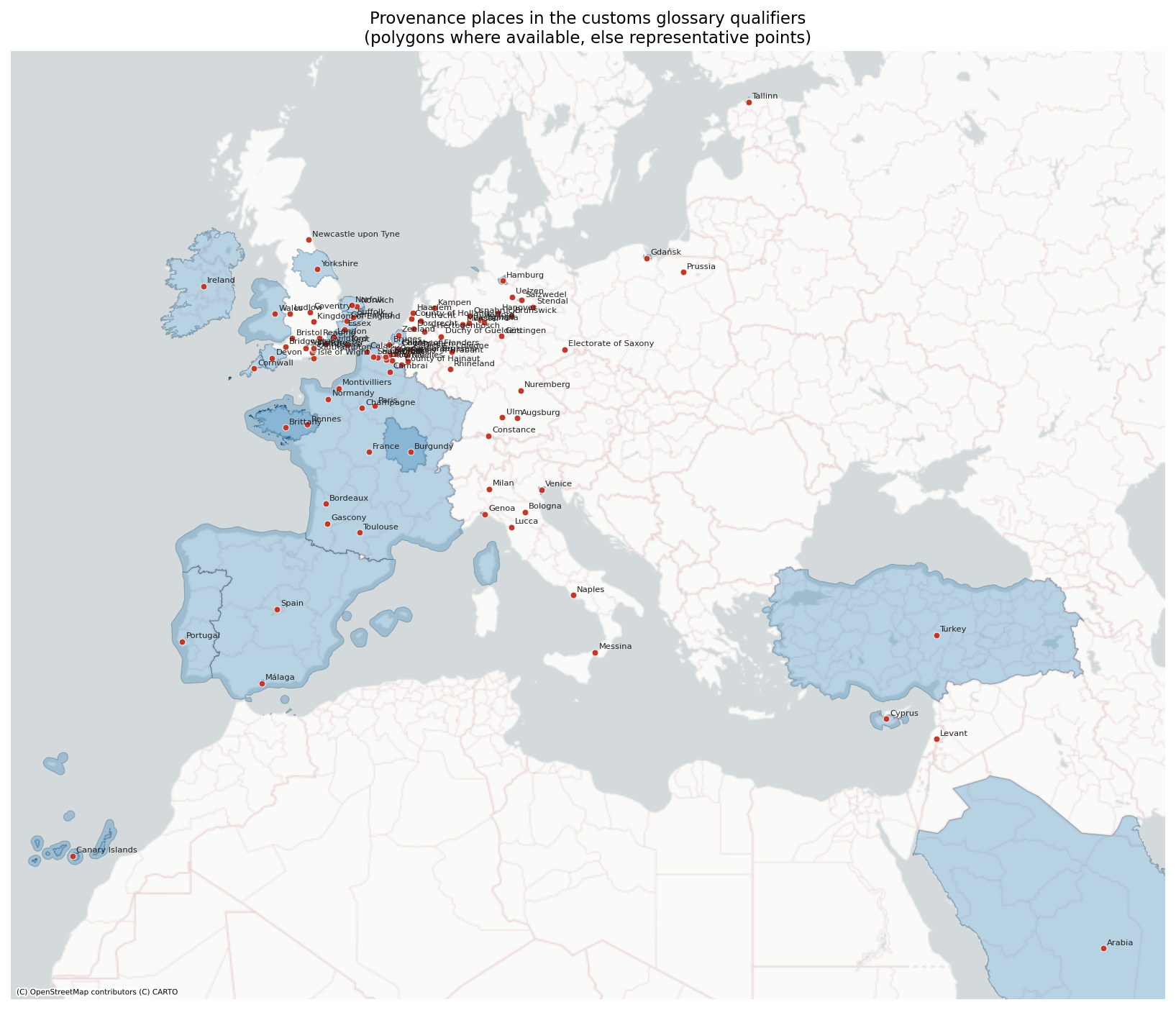
Two judgement calls are worth recording. Vitré (the canvas vitry) is kept as a qualifier but given no geographic identifier: like Flemish, it is a name-derived cloth-type whose provenance is implicit and not always reliable — the place a cloth is named for is not always where it was made. And bar (barras, a coarse packing-canvas) was removed from places altogether: it is a fabric, not an origin.
The cloth-type long tail, and a three-way split#
What remained after the themed batches was a long tail of ~210 low-frequency qualifiers — many attested only once: named fabrics (cogware, frieze, arras, florence, pikling), threads and their purposes (sewing, packthread, warp), paper grades (writing, printing, pressing), finishing treatments (tawed, bleached, dyed, moth-eaten) and a residue of genuinely obscure words. These were imported with the gloss the corpus already carries, variants were folded into the lemmas they belong to, and 60 one-off unknowns (bamme, holderne, wysk …) were deliberately not given canonicals — at migration they survive as raw forms rather than being forced into a false lemma.
The tail also forced a three-way split that the consonant-skeleton clustering
had collapsed into one. The skeleton vtr had merged three unrelated lexemes:
vetus / old (on shoes, pots, carpets), vitrum / glass (on bottles,
beads, paternosters), and vitry, the canvas named after Vitré. The
glossary’s own per-entry descriptions disambiguate them — veteri glossed “old”
on a shoe but “a light, durable canvas” on canvas — so each became its own
canonical (old, glass with its AAT material concept, and vitry with no
provenance), with the overlapping spellings free to appear in more than one,
because the parser resolves them from the commodity each qualifies, not the spelling
alone.
A couple of points carried forward for later:
Material qualifiers as explicit/implicit. Material qualifiers (cloth of gold) are kept in
qrather than a separate facet, but a later refinement may tag them explicit-vs-implicit, so that materials a record states and materials a concept implies can both be aggregated for analysis.Uncertain forms. A few spellings (e.g. ronyche, tukkid — “some kind of hemp, meaning unknown”) have no confident lemma. The form schema does not yet carry a per-form uncertainty flag, so these are held aside rather than folded in; a flag could be added if the need recurs. This document is updated as each batch is signed off.